
Study and work in Korea
Before you come to Korea, try it first
Rehearse your first interview and plan a day in Seoul. Prepare to study in the PATH app; job preparation opens next.
Your first interview, here first
Three interviewers ask and you answer in Korean: a 60–90 second practice. The first is a caregiver interview — type or speak on a PC, or sit in the interview room on a Quest.
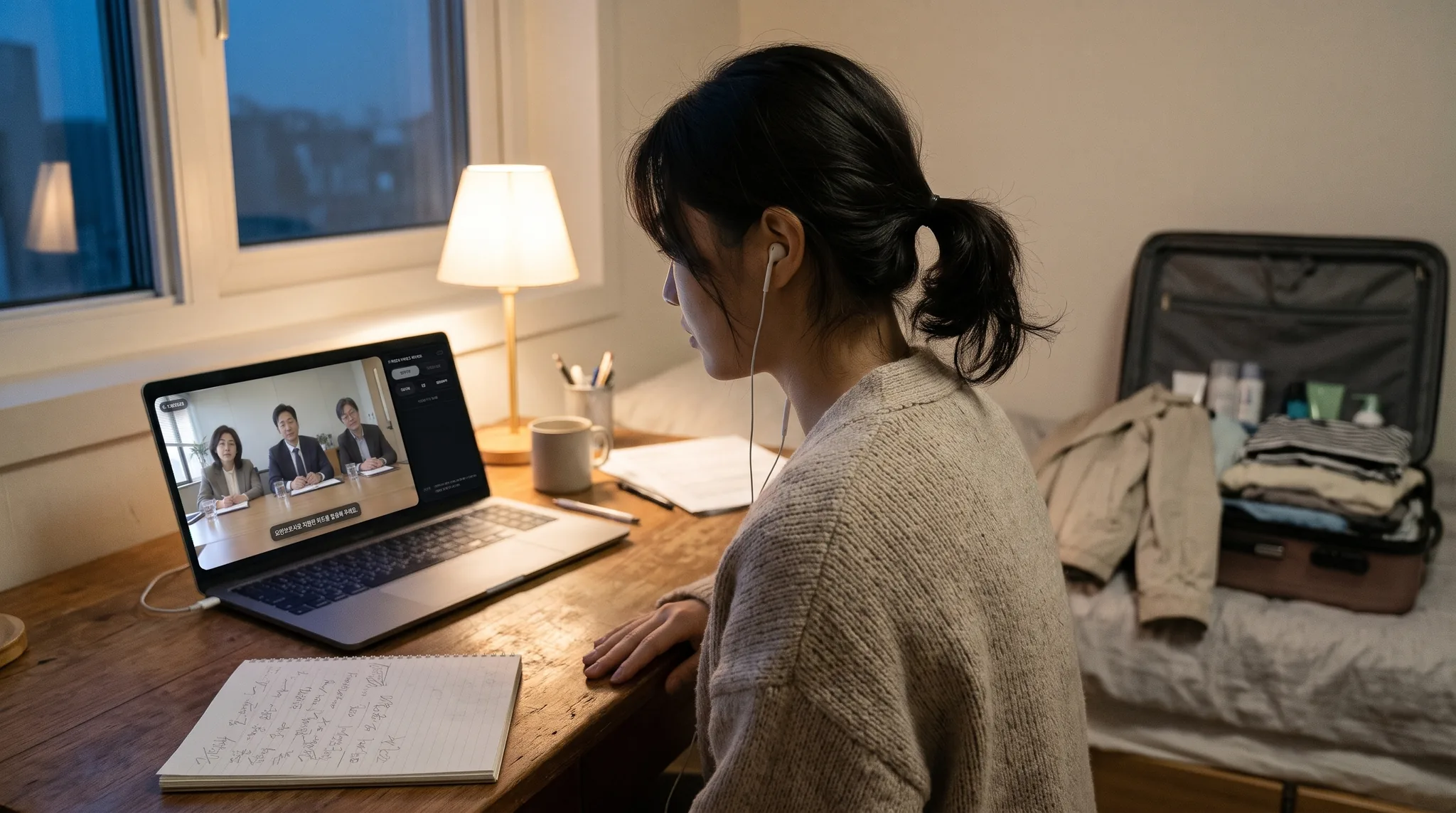
This plays sound — you hear one question here and answer it in the interview practice.


A day in Seoul · free
Three hours in Seoul, what will you do?
What do you feel like today? Up to three
How much time do you have?
Example — Wednesday 11 November 10:00 from 안국역 → 12:50 · 3 stops · walking 11–25 min
- 1 · 10:08–10:53운현궁Palace · 45 min there 4–8 min walk
- 2 · 11:02–11:52어니언 안국Tea · 50 min there 4–9 min walk
- 3 · 12:00–12:50북촌 한옥마을Sightseeing · 50 min there 3–8 min walk
Check opening hours and prices before you visit · Map © OpenStreetMap contributors
The road
From packing your bags to settling in
Three things are open now: a day in Seoul, preparing to study and interview practice. The other three open in the order you meet them.
A day in Seoul
Pick what you feel like and how long you have, and your day is planned — no sign-up.
Try it abovePreparing to study
Compare university requirements and keep track of documents in the PATH app.
Open the PATH appWhat it covers
In the PATH app you compare your own conditions with each university’s admission guide and keep track of the documents and deadlines for the program you choose. The support below, with a consultation, is being prepared.
Study plan Organize your goals, budget, Korean level and application timing, compare candidate schools and set a timeline.
Applications and interviews Polish the application documents you have written, practise for interviews, and check deadlines and what to do before you leave.
Portfolio Show what you have learned and done through your study plan and your own work. Only material you have checked and agreed to share is ever shared.
The scope, schedule and cost of support are agreed after a consultation.
Job requirements
For the job you want, the requirements first, in order.
What it covers
Working in Korea takes a different visa, qualifications and level of Korean in each field. For fields that need a qualification, such as care work or manufacturing, we are preparing to set out what you need and by when, step by step and from your point of view.
- Visa, qualification and Korean requirements by field
- Qualification training and exams follow the accredited bodies’ guidance
- Reminders for exam and document deadlines, and interview practice
Interview practice
Rehearse a caregiver interview in 60–90 seconds.
Listen aboveHousing
Finding a place to live in Korea, with you.
What it covers
We are preparing to help people coming to Korea for study or work choose where to live and start daily life.
Conditions and comparison Set out your length of stay, budget and distance to school or work, and compare the homes you can choose from.
Moving in Find out what you need at the start, such as move-in dates, what to bring and how the facilities work.
When something goes wrong Get help reporting problems with the building or daily life to the operator.
Partner operators, areas and costs are not decided yet, and we are not taking move-in bookings. Contracts and the running of buildings are handled by the operator.
Settle Together
Your first 30 days of to-dos, seen through with you.
2027 pilot
What it covers
Settle Together stays beside people who have just arrived in Korea, from the first day until they have settled in. It does not stop at telling you what must be done in the first 30 days — registering as a foreign resident, opening a bank account, health insurance — but checks with each person that it is done.
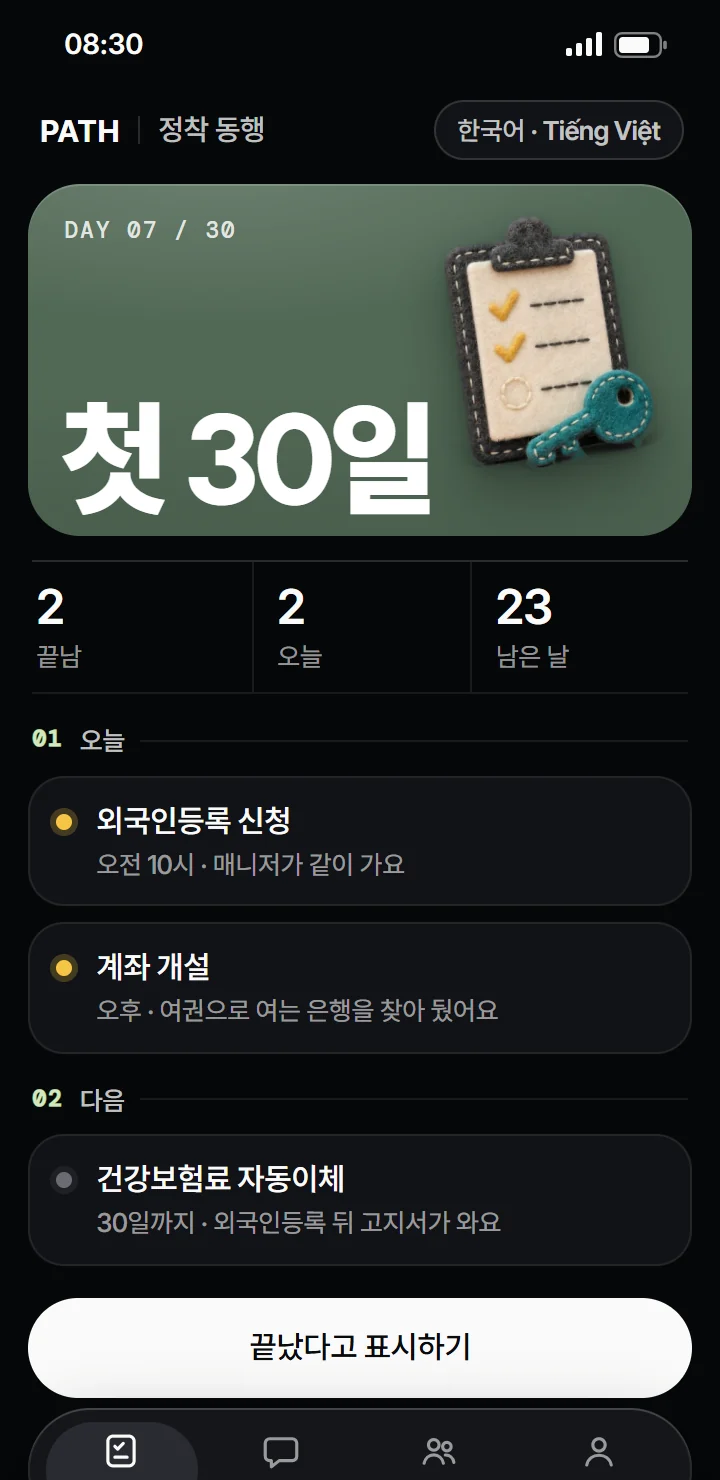
The first 30 days, today’s to-dos The app tells you what to do and by when, such as registering as a foreign resident, opening a bank account and paying health insurance. You mark each task done yourself, and if Korean is still hard for you, a manager goes with you. 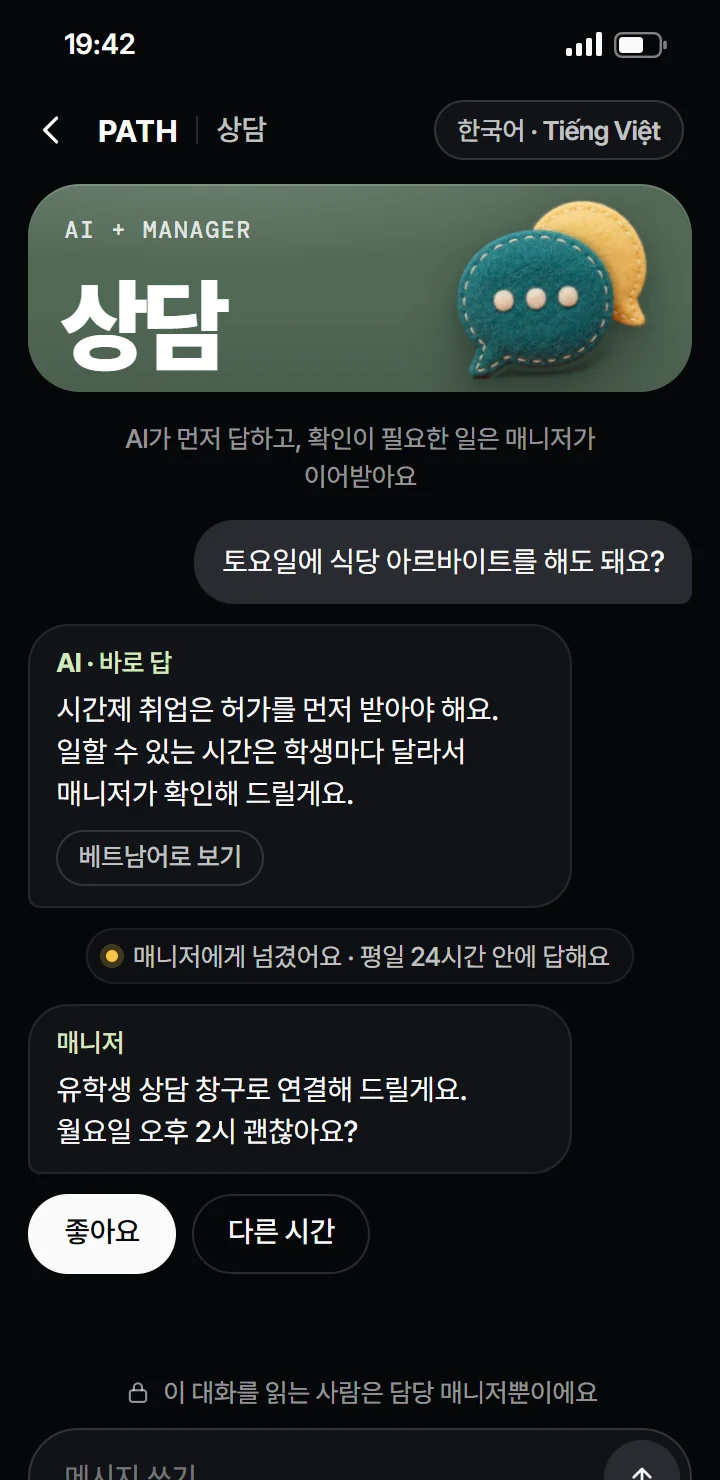
AI first, then a manager Ask a question and an AI answers first in several languages; anything a person needs to check is taken over by a manager who counsels in plain Korean. Visa, administrative and legal problems go straight to the existing counselling services, and anything involving life or safety starts with the emergency numbers. 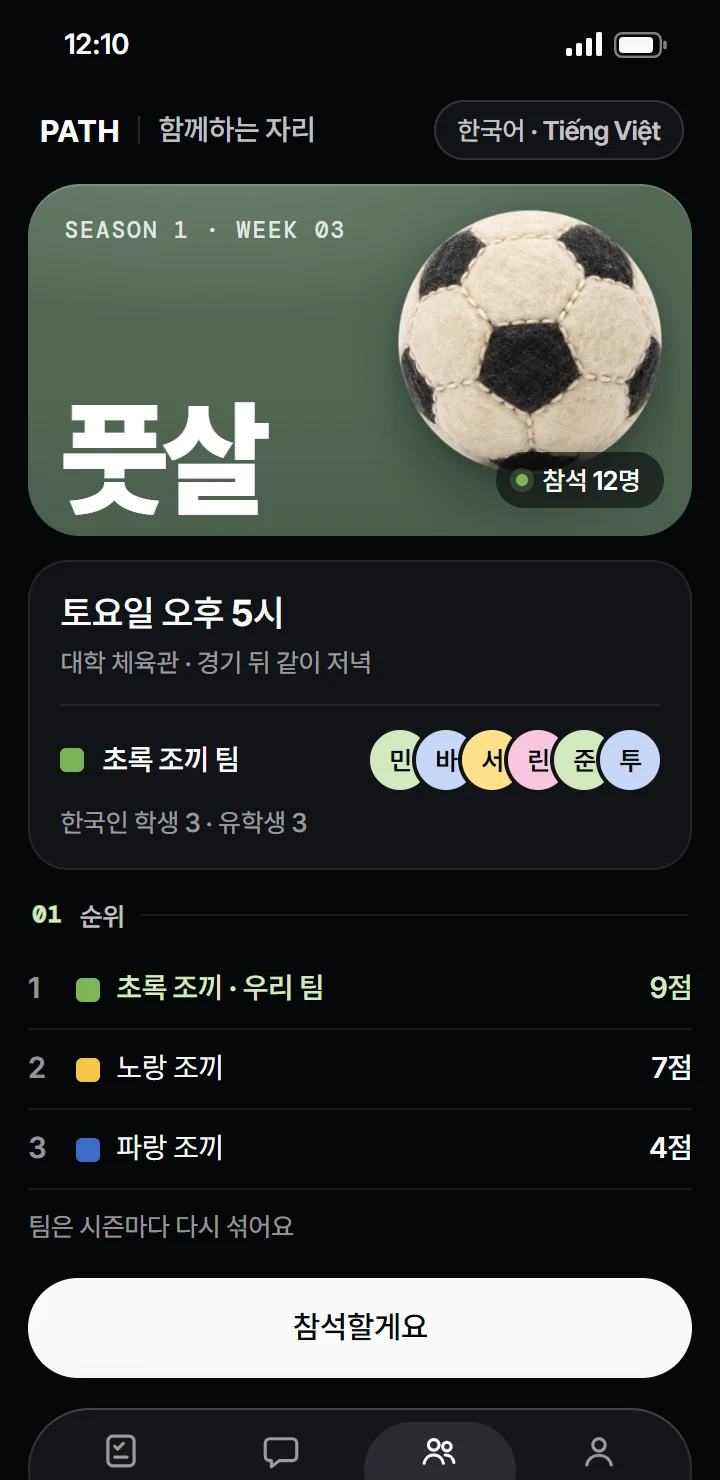
One team with Koreans International students and Korean students and residents play a season league every other week on mixed teams, and there are cooking and language-exchange meetups. Teams are reshuffled every season, and dinner after the match is alcohol-free. Quarterly settlement indicators Every quarter we measure the share who finished the required paperwork of the first 30 days, how long it took to first answer a question, the share of people who lost touch and were found and helped, the share who came back to meetups, and how many Koreans took part. Partner institutions receive only totals in which no one can be identified.
Principles we keep You take part only with your consent, and we do not take foreign resident registration numbers or passport numbers. What you tell us is not used for enforcement, and participants pay nothing for the core support.
The 2027 pilot From March to August 2027 (spring semester and summer break), we are preparing a pilot in which a dedicated manager and senior international students look after 30–50 people. App notifications and the AI first reply will be open to up to 200 people once the app is released (target: February).
The app screens are mockups in Korean, and the names, numbers and dates in them are examples. Existing institutions keep their counselling and education as they are; we add follow-through to the end and settlement indicators. We are not taking applications yet.
Ask
Ask us anything
Questions about what we have published are answered right here. For consultations and proposals, email us.
The contact form opens in Google Forms in a new tab.
Common questions07
We do not save the conversation. Please do not include personal information.